Technical overview · Illustrative patterns. Check the linked Microsoft documentation for current product requirements before implementation.
1. Microsoft Fabric creates the shared analytics foundation.
Microsoft Fabric brings ingestion, data engineering, data science, warehouse, real-time and Power BI experiences together around OneLake. The architectural advantage is not that every workload becomes identical; it is that teams can work over a shared data foundation with common governance and fewer unnecessary copies.
2. OneLake reduces data fragmentation.
OneLake is the unified logical data lake in Fabric. Data can be stored, governed and reused across multiple Fabric experiences, while shortcuts and other connectivity patterns can reduce unnecessary duplication where appropriate.
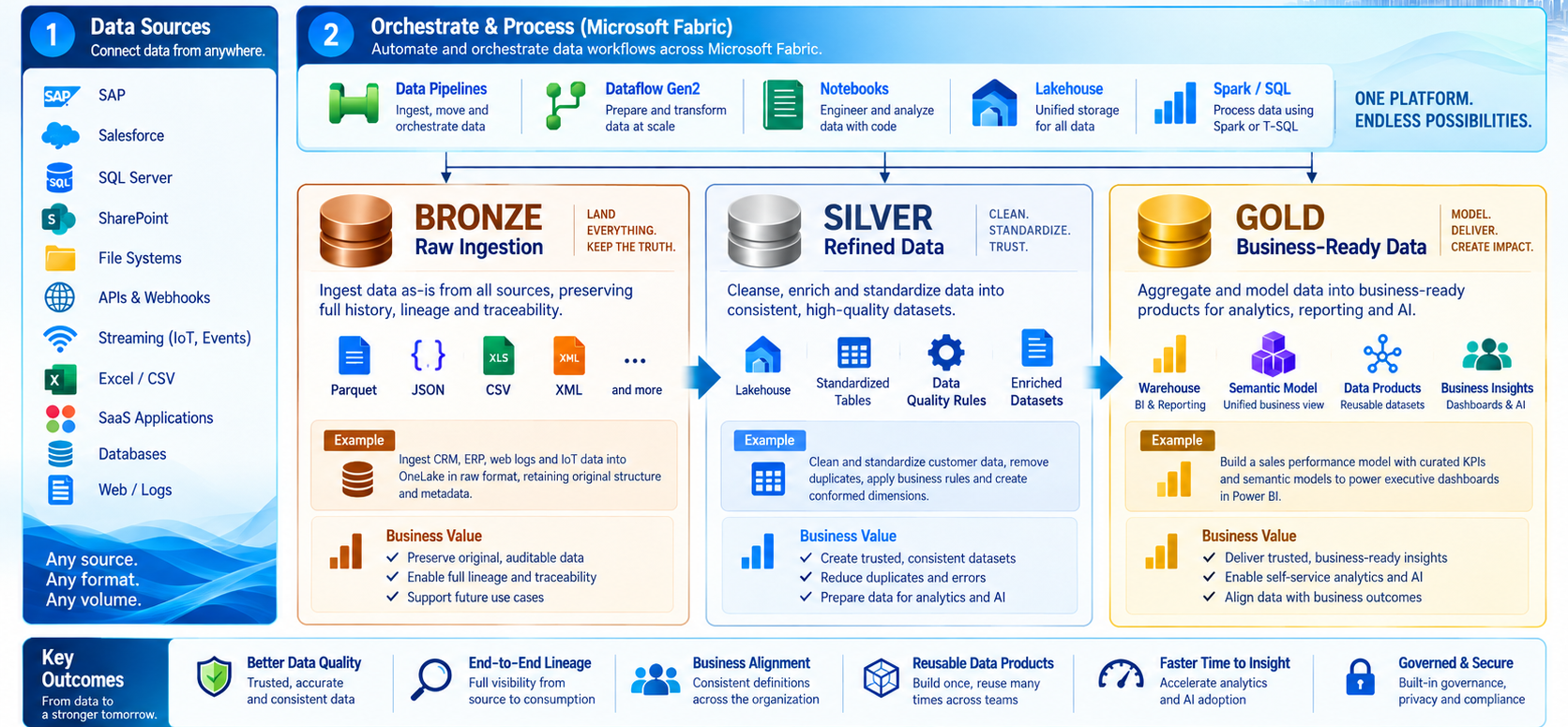
3. Medallion architecture improves data quality in stages.
A common Fabric pattern separates raw Bronze data, enriched Silver data and curated Gold data. The purpose is to preserve source truth, improve quality incrementally and publish business-ready data products for analytics and AI.
Microsoft Fabric Medallion Architecture
Bronze → Silver → Gold for governed, reusable and business-ready data.
4. Semantic models create business meaning.
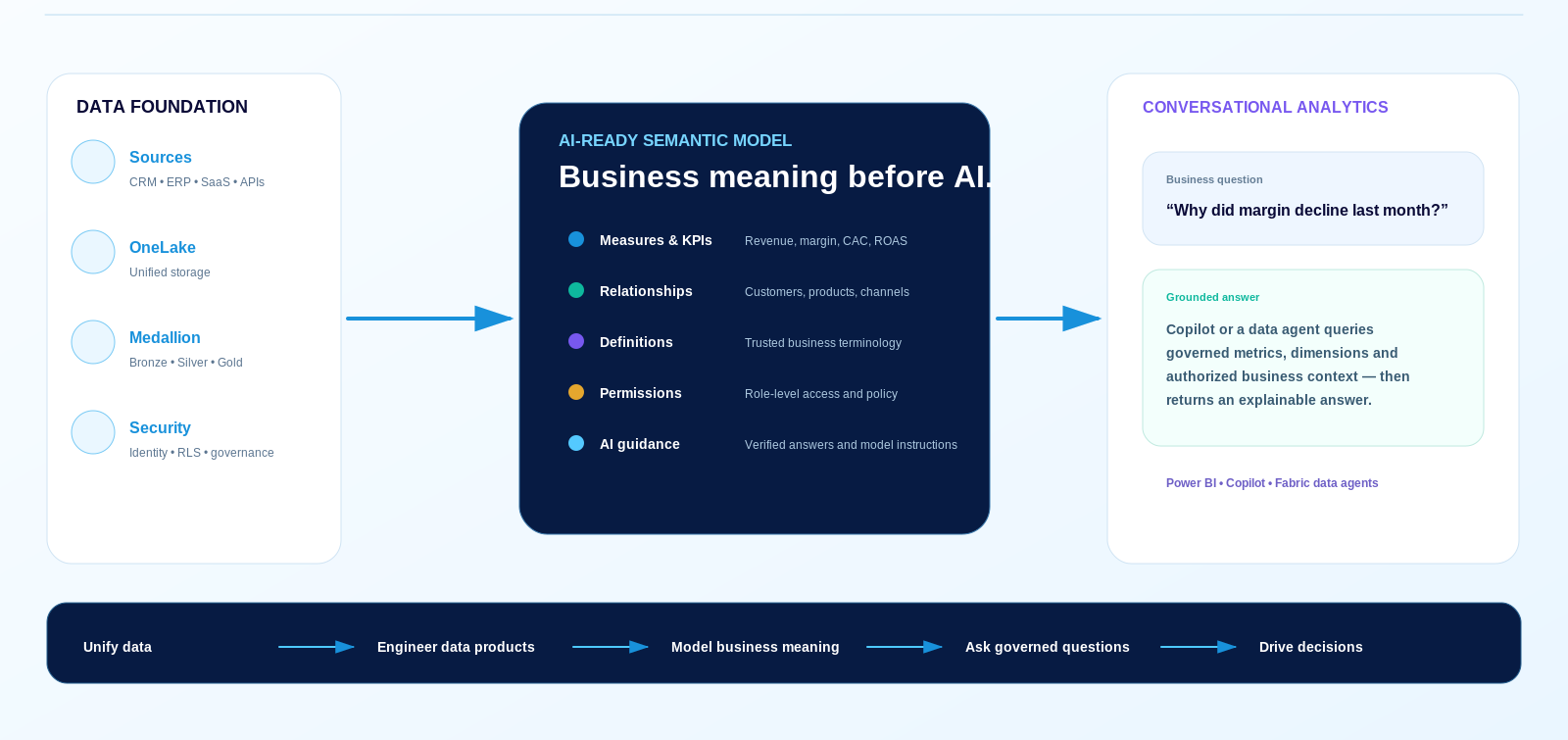
Copilot can only be as useful as the context it can rely on. A strong semantic model defines measures, dimensions, relationships, terminology and security so Power BI and conversational analytics work from governed business logic.
From Microsoft Fabric to Copilot
Build governed business context before asking AI to answer.
5. Copilot is a consumption experience—not a replacement for data engineering.
Power BI Copilot experiences can help users explore reports and semantic models conversationally, while Fabric data agents extend natural-language access to supported Fabric data sources. Licensing, capacity, permissions, region and current feature status must be assessed before rollout.
6. Design the architecture around decisions.
Start with the questions executives and teams need to answer. Then identify the source data, engineer reusable data products, model business meaning and choose the right consumption experience—Power BI, Copilot, applications or automated workflows.